Goal
The previous posts designed an on-site plant. Someone now has to buy it, often as a service: a provider owns the generators, the batteries and the controller, and the site buys energy or capacity under an energy-services agreement. The engineering does not stop at the specification. It moves into the contract’s performance terms, the review of the vendor’s drawings and test results, and the plan for what runs before the permanent plant exists.
This post works through the technical side of that: how to read an availability guarantee, what to ask of a vendor, how an acceptance test compares a claim with a requirement, and how a temporary plant hands over to the utility.
Terms used in this post
- Energy-services agreement: a contract in which a provider supplies energy or capacity from equipment it owns or operates on the customer’s site.
- Availability: the fraction of hours that a unit or plant can deliver its rated output, with a stated definition of which outages count.
- Forced and planned outage: an unplanned loss of a unit, and a scheduled maintenance outage.
- Force majeure: events outside a party’s control that the contract excludes from the performance measure.
- Submittal: a vendor document sent for review before manufacture or installation, such as a data sheet, a drawing or a calculation.
- Shop drawing: a vendor’s detailed manufacturing or installation drawing.
- Deviation request: a vendor’s formal request to depart from a specified requirement.
- FAT and SAT: factory acceptance test and site acceptance test.
- Bridging power: temporary generation that energizes a site before the permanent utility service or plant is ready.
- Liquidated damages or service credits: a pre-agreed payment for a performance shortfall.
What I built
bmc/esa.py, with five small calculations: availability in hours, the plant-level result of unit-level guarantees, expected shortfall and its value at an assumed credit, an acceptance comparison for a vendor’s step, ramp and ride-through claim, and the sequence for a bridging hand-over. A figure of plant-level shortfall. All figures are assumed.
How it works
Diligence on a vendor
The earlier posts supply the questions. Each is a place to ask the vendor for data.
- Generation providers. The unit rating at the site’s temperature and altitude, the guaranteed heat rate, the emissions at each load point, the load acceptance in steps, the class under ISO 8528-5, the fuel quality it needs, the maintenance intervals and how the provider covers a unit out, and a reference list of sites with similar duty.
- Battery integrators. Power and energy at the end of life and not at day one, the inverter’s mode (grid-forming or grid-following) and its ride-through and fault current, the UL 9540 listing and the UL 9540A test report, the NFPA 855 compliance for the enclosure and spacing, the thermal management and the warranty’s conditions on cycling.
- Microgrid controller vendors. The functions it implements (islanding, resynchronization, black start, dispatch), the integration with SCADA and the EPMS, how it fails, how it is tested and whether it has run an island that resynchronized.
- Everyone. Whether the standards the project cites are the ones the product is listed or tested to, whether the models are provided for the studies, and who is on the hook for each interface.
Reading an availability number
An availability number is meaningless without three definitions: of what, measured how, and with which outages excluded. 99 percent available is 88 hours down a year, 98 percent is 175 hours, and 90 percent is 876 hours, and the exclusions of planned maintenance, fuel supply and force majeure can make the guaranteed figure and the delivered one differ. The customer cares about the plant, not the unit, so the contract should name the plant-level number the site needs.
Unit guarantees do not add up to a plant guarantee
Three units are needed for the load and each is guaranteed 96 percent available. With exactly three installed the plant carries full load 88.5 percent of the time, which is about 1,010 hours a year short. A fourth unit lifts it to 99.1 percent and 80 hours short, and a fifth to 99.94 percent and 5 hours. The spare units are what makes the plant number, and who pays for them is a commercial term.
Acceptance
A requirement is a number and a test. For the step load the specification says the plant takes a given step within a given time, with a ramp and a ride-through. The vendor submits a claim backed by data. An acceptance table compares the two, and any shortfall becomes a deviation request: the vendor states the departure, its effect on the site and a remedy, and the owner accepts or rejects it. The factory test and the site test then check the number on the equipment, with the same load profile the model used.
Bridging power
When the utility service will be late, temporary units energize the site first. The transition has a sequence: the bridge plant runs the site as an island, loaded in blocks; the utility is energized and its protection checked; the bridge is synchronized to the utility under a synchronization check; the transfer is closed-transition, with the bridge ramping down under the controller; the bridge is removed or kept as a reserve; and the integrated test is rerun with the permanent settings. The sequencing, the protection and the controls are the same ones the microgrid post described, with one extra difficulty: the protection settings change at each step, and the temporary equipment may differ from the permanent equipment in its fault current and its response.
Commands and results
python3 bmc/esa.py hours plant shortfall accept bridge
python3 bmc/esa.py plot esa.png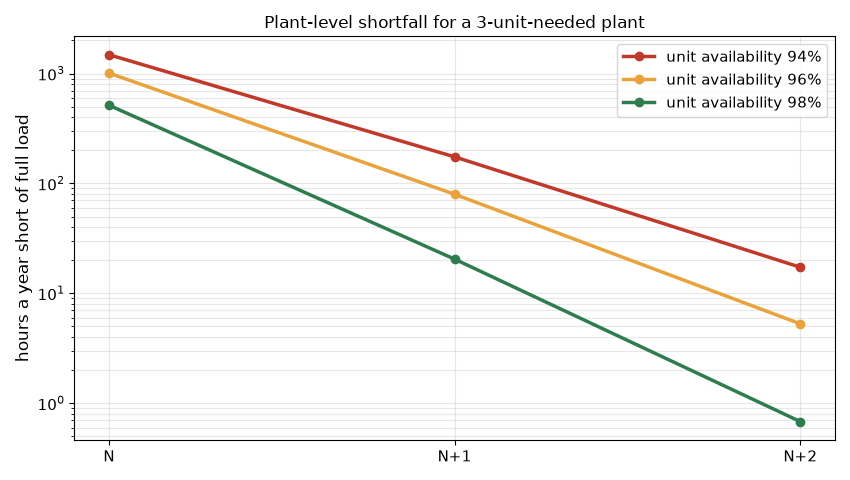
Plant against unit. At 96 percent per unit, N units give 88.5 percent plant availability, N+1 gives 99.1 percent and N+2 gives 99.94 percent. The log scale in the figure shows how much each spare buys: about an order of magnitude of shortfall hours.
Remedy. Four units at 96 percent have an expected shortfall of 0.0093 units, about 2.3 GWh a year of undelivered capacity. At an assumed credit of 100 dollars per MWh that is about 235,000 dollars a year, which is the order of what a remedy clause is worth to the owner and what the provider carries as risk.
Acceptance. For a required 20 MW step in 10 s at 2 MW/s with 150 ms of ride-through, a vendor claim of 14 MW meets the time, the ramp and the ride-through but not the step, and needs a deviation request.
Challenges
- Definitions decide the guarantee. A provider that excludes fuel interruptions from availability is not providing the availability the site needs when its fuel is the failure mode. The exclusions are read as carefully as the number.
- Unit data is not plant data. Reliability data for single units says nothing about common-cause failures: the shared gas supply, the shared controller, the shared cooling. The contract measures the plant at the point the site connects.
- Vendors submit what they have. A submittal may show a standard product that differs from the specification in small ways. A review that checks each against the requirements, and tracks each deviation to closure, is what keeps the plant to the design.
- Interfaces fall between scopes. The generator vendor, the battery integrator and the controller vendor each own part of an island transition. The owner or the engineer of record writes the interface requirements and the integrated test.
- Temporary equipment is permanent for months. A bridging plant runs for a long time and needs fuel logistics, permits, protection and operators for its whole stay.
- Models are deliverables. Without a validated dynamic model from each vendor the studies in the previous post cannot be run. The contract lists them as deliverables with a date.
Production setup example
An energy-services agreement has a technical exhibit that states the plant’s required output at site conditions, the availability measured at the point of interconnection, the response to steps and to disturbances, the power quality limits, the ride-through requirements, the emission limits, the test regime and the remedies. A design review log tracks every submittal and deviation request. Factory witness testing proves the machines and the controls, site testing proves the integration, and the integrated systems test in the commissioning post proves the whole.
The teaching numbers are assumed. A real exhibit takes them from the site’s load profile, the utility’s requirements and the studies.
FAQ
What does availability mean in a contract?
The fraction of hours a unit or a plant can deliver its rated output, with a definition of which outages count. The number is not comparable without the definition.
Why do unit guarantees not give a plant guarantee?
The load needs several units at once, so the plant is available only when enough units are. Spares raise it.
What is a deviation request?
A formal request from the vendor to depart from a specified requirement, with its effect and a remedy, for the owner to accept or reject.
What is bridging power for?
Energizing a site before the permanent service or plant is ready, then handing over to it.
Who owns the interfaces?
The owner or the engineer of record, who writes the interface requirements and the integrated tests across vendors.
What does this post not show?
A contract or a negotiation. It shows the technical questions, the arithmetic behind a guarantee and the checks a review makes.
Repeating with real hardware
Coming soon. The nearest repeat is to take a published availability guarantee from a vendor data sheet and write the plant-level number it implies for a given N.
Next
Take the quiz to test your understanding: Electrical series quiz
The next post in this series covers metering, monitoring and PUE.
Comments