Goal
With generation and a battery on the site, the site stops being only a customer of the grid. It can be connected and share load with the utility, it can separate and carry itself, and in the worst case it can start from nothing. A microgrid is the name for that arrangement and the controller is its brain. This post takes the example site through the modes and the transitions between them: how it separates from the utility, what it sheds when generation is short, how it restarts from a dead bus, and how it reconnects without breaking anything.
We use the same 62.4 MW site, the 28.7 MW derated units from the generation post and the grid-forming battery from the previous post.
Terms used in this post
- Microgrid: a group of interconnected loads and distributed energy resources with clearly defined electrical boundaries that acts as a single controllable entity with respect to the grid and can connect and disconnect from it. This is the definition in IEEE 2030.7.
- PCC: the point of common coupling, the breaker where the microgrid meets the utility.
- Intentional island: a planned separation from the utility, with the microgrid energizing its own loads.
- Unintentional island: an island that forms by accident, for example when the utility opens a breaker and local generation keeps the section alive.
- Anti-islanding: protection that detects an unintentional island and stops local sources from energizing it.
- Black start: restoring a plant from a dead state, with no grid, using a source that needs no outside power.
- Resynchronization: reconnecting the island to the utility with voltage, frequency and phase angle matched.
- Load shedding: dropping loads in a planned order when generation is short.
- MGC: the microgrid controller.
- EPMS and SCADA: the electrical power monitoring system and the supervisory control and data acquisition system that the controller must integrate with.
What I built
bmc/microgrid.py, with four parts: an islanding timeline, load shedding by tier against the generation available, a black start in blocks sized to what a unit accepts, and the closing window for resynchronization. A two-panel figure. Times and limits marked A are assumptions in the script.
How it works
Modes and stages
The mode list in a microgrid specification is short: grid-parallel, islanded and black start, with transitions between them. A NREL overview of intentional islands describes the operational stages as parallel operation, transition to islanding, island operation and transition back to parallel operation, and says black start is an operational state that planners must consider, though the standards it surveys acknowledge it without discussing it in detail. It also describes designations a resource can carry: intentional-island capable, black-start capable, isochronous-capable or uncategorized. An isochronous source holds frequency constant and sets the island’s reference, which is the role of the grid-forming battery or one generator.
The standards that frame it
- IEEE 2030.7-2017, the standard for the specification of microgrid controllers, addresses the functions above the component control level that are common to all microgrids, regardless of topology, configuration or jurisdiction, and covers testing procedures.
- IEEE 1547-2018 sets the rules for distributed resources connected to the utility. The NREL overview quotes its requirement that when an unintentional island forms the resource must detect it, cease to energize and trip within 2 seconds. It also quotes the synchronization requirement: resynchronizing an intentional island is done by matching voltage amplitude and phase angles before reconnecting.
- IEEE 1547.4, the guide to intentional islands, is shown by IEEE as a revision project in progress, superseding the 2011 edition.
What the controller does
A DOE compendium of microgrid controller functions lists the operations: activation, black start, on-grid optimization, intentional islanding, unintentional islanding, off-grid optimization, intentional resynchronization, unintentional resynchronization, shutdown and optimization such as economic dispatch. Its entry for unintentional islanding says the controller can recognize a non-requested opening of the point of common coupling and automatically swap the voltage and frequency device to the proper mode so that the island forms without interrupting power to the load. In our site that device is the grid-forming battery.
The controller sits above local controls. Each generator has its governor and its protection, the battery has its inverter, and the PCC has a protection relay. The controller sets modes and set points and coordinates the transitions. It is integrated with the site’s SCADA and with the EPMS so operators see the mode and the state of every source, and the transitions are tested because no one wants to learn how they behave from a real outage.
Islanding, shedding and restarting
Islanding. The sequence in the script is: the utility opens or the PCC protection opens it, the UPS batteries carry the IT load for the first instants, the grid-forming battery takes the voltage reference within a tenth of a second, generators start on the controller’s command and parallel after reaching speed and voltage, then pick up load in steps while the battery’s power falls back to zero.
Load shedding. If fewer units are available than the load needs, the controller drops loads in a planned order. Our site has five tiers: core network, storage and inference (14 MW), cooling (10 MW), training halls (32.1 MW, curtailable by a software power cap), non-critical IT and offices (4.3 MW) and site services (2 MW).
Black start. The first source must start without outside power: a battery with a grid-forming inverter, or a diesel unit with its own starting system. Transformers are energized one at a time because of magnetizing inrush, and load is added in blocks no larger than a generator can accept.
Resynchronization. The island and the utility have slightly different frequencies, so the phase angle between them drifts. The controller adjusts the island’s speed to slow the drift and closes the breaker when frequency, voltage and angle are inside their windows, issuing the close command early to allow for the breaker’s closing time.
Commands and results
python3 bmc/microgrid.py island shed blackstart resync
python3 bmc/microgrid.py plot microgrid.png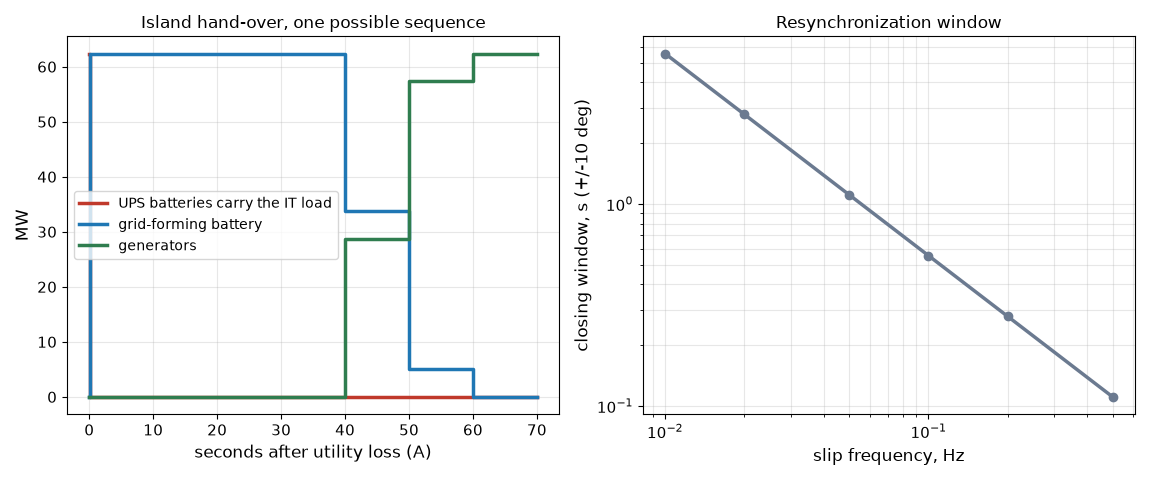
Hand-over. With the assumed times, the grid-forming battery holds the island from 0.1 s until the generators are paralleled at about 30 s and picked up by about 60 s. The battery has to carry up to the whole load for that interval in this example: 62.4 MW for 30 s is 520 kWh, again a power-sized duty.
Shedding. With two derated units online, 57.4 MW against a 62.4 MW load, the controller sheds site services (2.0 MW) and non-critical IT (4.3 MW) and carries 56.1 MW. With one unit, 28.7 MW, it must also cap the training halls (32.1 MW) and carries 24.0 MW. Software power capping on the training cluster is the lever that avoids dropping the critical tiers.
Black start. With two units online, blocks of 25 percent of online capacity are 14.3 MW and restoring 62.4 MW takes five blocks, about 0.8 minutes at 10 s per block after the units are at speed. Block size and spacing are set by the generator’s load acceptance and the cooling plant’s restart sequence.
Resynchronization. At a slip of 0.05 Hz the angle drifts 18 degrees per second, so a closing window of plus or minus 10 degrees lasts 1.1 s. A 0.2 Hz slip leaves 0.28 s. A five-cycle breaker closes 83 ms after the command, which is 1.5 degrees of drift at 0.05 Hz, so the command goes out 1.5 degrees early.
Challenges
- Customer-side transfers can look like a fault. NERC’s incident review of the July 2024 event in Virginia says about 1,500 MW of data center load left the grid by customer protection during six faults in 82 seconds, with most of it, about 1,260 MW, going at the third voltage depression. Some data centers use a scheme that counts voltage disturbances, typically three within a minute, and transfers to backup power until someone reconnects manually. A microgrid controller’s transfer logic is part of what the grid operator sees, and the thresholds should be chosen with that in mind.
- Reconnecting is also a load event. The same review notes that ramp rates for load reconnection matter as much as generation ramps and that reconnecting large amounts of load in an uncontrolled way creates its own problems. Returning to the grid is staged, not a single breaker close.
- A mode confusion is an outage. If the controller believes it is islanded while the PCC is closed, or the opposite, its set points fight the grid. Mode is derived from breaker positions and checked against measurements, and operators see the same mode the controller does.
- The controller is a single point of failure. It is duplicated, its failure leaves the local controls in a safe default, and it can be bypassed manually. Its network and its time source are part of the reliability design.
- Islands need protection that works at island fault levels. An island fed by inverters supplies far less fault current than a grid-connected one, so relays validated in one case may fail in the other. The previous post gives the numbers.
- Cold load pickup is real. After an outage of any length, load comes back with all the equipment at once: fans, pumps and power supplies charging capacitors. Restoration is in blocks, with the cooling plant sequenced before the IT load it supports.
Production setup example
A microgrid specification for a data center names the modes, the transition times for each, the conditions that permit a transfer, and the tests that demonstrate them: a planned islanding, an unplanned islanding, a resynchronization and a black start, each with a pass criterion in volts, hertz and seconds. The controller is specified by function, with the functions the DOE compendium lists, and by its integration with the site’s SCADA and EPMS. The commissioning post in this series gives the integrated test script that includes these.
The teaching numbers here are assumed times and limits. A real design takes them from the generator and battery vendors, the utility’s interconnection requirements and the protection study.
FAQ
What is the difference between intentional and unintentional islanding?
Intentional islanding is a planned separation in which the microgrid energizes its own loads. Unintentional islanding happens by accident, and anti-islanding protection exists to stop local sources from energizing it.
Why does IEEE 1547 require a trip within 2 seconds?
An unintentional island can be energized at the wrong voltage and frequency and can be unsafe for utility crews. Distributed resources must detect it and cease to energize.
What starts a black start?
A source that needs no outside power: a battery with a grid-forming inverter or a generator with its own starting system. Everything else is added in blocks.
Why does resynchronization need a window?
The two systems run at slightly different frequencies, so the angle between them drifts. The breaker should close when angle, voltage and frequency are inside limits that the equipment tolerates.
What does the controller do that the local controls cannot?
It sets modes, sets points and sequences the transitions across sources, using information none of the local controls has.
What does this post not show?
A controller, a protection study or a test. It shows the sequence, the arithmetic of the transitions and the questions a specification must answer.
Repeating with real hardware
Coming soon. The nearest repeat is an open-source microgrid simulation or a controller vendor’s test bench running the same four transitions.
Next
Take the quiz to test your understanding: Electrical series quiz
The next post in this series covers protection at the utility connection: relays, settings and anti-islanding.
Comments