Goal
The utility is not always ready when the building is. The earlier posts assumed a utility service, a generator for backup and a UPS for the gap. This post treats generation as a primary source: a plant on the customer’s side of the meter that carries the site, in parallel with the grid or alone. We use the same example site, 62.4 MW at the meter, and work through the decisions an engineer makes before a vendor is chosen.
Four questions drive the design. Which prime mover: a reciprocating gas engine, a gas turbine or a fuel cell? How many units, after hot-day and altitude derating, for N, N+1 and N+2? What does the fuel system and the air permit require? And how does a plant sized for 20 halls behave when only 4 are built?
Terms used in this post
- Prime mover: the machine that turns fuel into mechanical or electrical power, here an engine, a turbine or a fuel cell stack.
- Reciprocating engine: a piston engine, spark-ignited on gas or compression-ignited on diesel, driving a generator.
- Aeroderivative and frame turbine: gas turbines adapted from aircraft engines (compact, fast to install) and purpose-built industrial turbines (larger, heavier, longer between overhauls).
- Lean burn: running an engine with excess air to lower the peak temperature and so the NOx.
- Dry low NOx (DLN): a turbine combustor that premixes fuel and air to keep NOx low without water injection.
- SCR: selective catalytic reduction, an exhaust catalyst with ammonia or urea that removes NOx.
- ppmv at 15 percent O2: the standard way to quote NOx in an exhaust, corrected to a fixed oxygen content so that dilution does not flatter the number.
- LHV and HHV: lower and higher heating value of the fuel. Efficiency quoted on LHV is higher than on HHV for the same machine.
- N+k: enough units that k can be out of service and the load is still carried.
- Derating: the loss of output from altitude and heat.
- Title V and PSD: the federal operating permit program and the preconstruction permit program for major sources of air pollution.
What I built
bmc/ongen.py, a script that takes the 62.4 MW site and computes: unit counts for three technologies after derating, the probability that enough units are up for N, N+1 and N+2, NOx in tons per year at three control levels, a phased build from 4 to 20 halls, and diesel storage. A figure of the NOx and availability results. Inputs marked A in the script are assumptions and the rest come from the sources linked below.
How it works
The three prime movers
EPA’s Catalog of CHP Technologies characterizes each. We use it as the source for sizes, efficiency and emissions.
Reciprocating engines are available from 10 kW to over 18 MW. Natural gas engine electric efficiency ranges from 30 percent LHV for small stoichiometric engines to over 46 percent LHV for large lean burn engines above 3 MW. They start fast, which the catalog ties to peaking and emergency use, and keep good efficiency at part load. Diesel engines emit 5 to 20 times the NOx of a lean burn gas engine on a ppmv basis, which is why diesel plants are limited in the hours they may run. Lean burn trades efficiency for NOx: at the lowest achievable NOx levels, 45 to 50 ppmv, almost 1.5 percentage points of efficiency are lost.
Gas turbines are available from 500 kW to over 300 MW. Dry low NOx combustors give NOx below 25 ppm, with laboratory data down to 9 ppm, and SCR takes it to single digits. Larger aeroderivative turbines (above 40 MW) have achieved over 43 percent simple-cycle efficiency (LHV), and industrial frame turbines above 100 MW approach about 40 percent simple cycle and 60 percent combined cycle. A turbine reduces output by reducing combustion temperature, so efficiency at part load is substantially below full-power efficiency. Time to overhaul is typically 25,000 to 50,000 hours.
Fuel cells. A solid oxide fuel cell converts gas to electricity without combustion. Bloom’s Energy Server 6.5 data sheet lists a 325 kW net AC module on natural gas at 12 to 18 psig, with no water in normal operation, a cumulative electrical efficiency of 65 to 53 percent LHV (heat rate 5,811 to 7,127 Btu/kWh HHV), and listings to UL’s stationary fuel cell standard and interconnection to IEEE 1547-2018. It describes operation in grid parallel or in a microgrid. The module size is why a 62 MW site is hundreds of units. The catalog, which dates from 2017, counts about 83.6 MW of CHP fuel cell installations in the United States, so a 62 MW plant would be a large step for the technology.
Derating
Output falls with altitude and heat. For engines the catalog gives about 4 percent per 1,000 feet above 1,000 feet and about 1 percent for every 10°F above 77°F. It says the effect on turbines can be significant and shows it in a figure without a single formula, so the script uses an assumed 0.5 percent per °F above 59°F. At an assumed site of 4,000 feet and 95°F, a 9.3 MW engine delivers 86 percent and a 35 MW turbine 82 percent.
Fuel, start-up and black start
EPA’s technology comparison table in the CHP catalog puts the three side by side, and the differences set the fuel system and the restart plan.
| Reciprocating engine | Gas turbine | Fuel cell | |
|---|---|---|---|
| Fuel pressure needed | 1 to 75 psig | 100 to 500 psig, with a compressor | 0.5 to 45 psig |
| Start-up time | 10 seconds | 10 minutes to 1 hour | 3 hours to 2 days |
| Part-load performance | ok | poor | good |
| Availability | 96 to 98 percent | 93 to 96 percent | above 95 percent |
| Hours to overhaul | 30,000 to 60,000 | 25,000 to 50,000 | 32,000 to 64,000 |
| NOx without SCR, lb/MMBtu | 0.17 lean burn | 0.036 to 0.05 | 0.0025 to 0.0040 |
The fuel pressure column is the gas supply specification. A turbine needs a pipeline lateral at a high enough pressure or a fuel gas compressor, with its own redundancy and power, and a compressor that trips takes the turbines with it. An engine takes a modest pressure, and a fuel cell as little as Bloom’s 12 to 18 psig input. All of them sit behind a fuel gas piping design under NFPA 54 and a gas utility’s delivery point, and a dual-fuel plant adds liquid storage under NFPA 30.
The start-up row is the black-start row. The catalog says reciprocating engines need minimal auxiliary power for black start, generally only batteries or compressed air, and describes packaged systems with islanding capability that can disconnect from the grid by an automatic transfer switch and run independently. A gas turbine needs a starting system and takes minutes to spool up, so it follows the first source. A fuel cell takes hours to days from cold, which the catalog says makes it less attractive for start-stop or load-following operation, so it is a base-load source that stays hot and that the grid-forming battery or an engine brings back online. In the microgrid post’s black start, the first source is therefore a battery or an engine, and the fuel cell modules and turbines join as they warm up.
Redundancy is a count
N is the number of derated units that carry the load. N+1 and N+2 add spares. The availability of the plant is the probability that at least N of M units are up. For independent units with availability a it is a binomial sum, and it is an upper bound because independence ignores shared fuel, shared controls and common-cause faults.
Emissions and permits
NOx in ppm becomes mass through the fuel burned. At natural gas conditions 25 ppm at 15 percent O2 is 0.092 lb/MMBtu (the conversion uses the standard dry F-factor for gas). The mass over a year, in tons, is compared with permit thresholds. Under the federal rule a Title V major source is one with the potential to emit 100 tpy or more of any air pollutant subject to regulation. For preconstruction review, 40 CFR 52.21 sets a general threshold of 250 tpy, and 100 tpy for a list of source categories that includes fossil fuel-fired steam electric plants above 250 million Btu per hour heat input and fossil-fuel boilers totaling more than that. Gas turbines and engines are regulated under their own standards: EPA’s page on turbine NSPS says subpart KKKK covers combustion turbines and their heat recovery units that began construction after 18 February 2005, and the reciprocating engine rule is subpart ZZZZ of 40 CFR part 63. We take the thresholds from the regulation text. The applicable limits for a real site depend on the state, the area’s air quality status and the permit writer.
Codes
Four NFPA documents recur in the generation basis of design. NFPA 37 covers installing and using stationary combustion engines and gas turbines. As summarized in trade articles it sets criteria for minimizing fire hazard, and it refers to NFPA 110 for engines in emergency power supplies. NFPA 110 covers emergency and standby power systems, including the Level and Type classes, where Type 10 means the system picks up the load within 10 seconds. NFPA 54 is the fuel gas code and NFPA 30 the flammable and combustible liquids code, which governs diesel storage. We read these as descriptions in secondary sources and not from the standards themselves.
Commands and results
python3 bmc/ongen.py units avail nox nox_tech phases diesel
python3 bmc/ongen.py plot ongen.png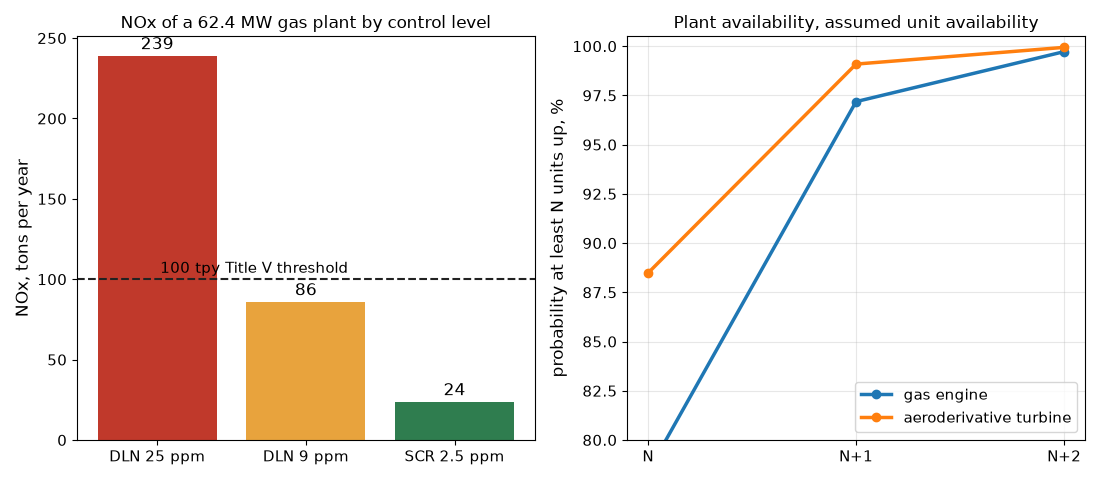
Unit counts. At the assumed site the load needs 192 fuel cell modules, 8 gas engines of 9.3 MW or 3 aeroderivative turbines of 35 MW. N+2 is 194 modules (63.1 MW installed), 10 engines (93 MW) or 5 turbines (175 MW).
Availability. The catalog’s availability ranges are 96 to 98 percent for engines, 93 to 96 percent for turbines and above 95 percent for fuel cells. With assumed unit availabilities of 99.5 percent for a fuel cell module, 97 percent for an engine and 96 percent for a turbine, in line with the top of those ranges, a plant of exactly N units is up 38 percent of the time for the fuel cells, 78 percent for the engines and 88 percent for the turbines. N+1 gives 75, 97.2 and 99.1 percent, and N+2 gives 92.6, 99.7 and 99.94 percent. To reach 99.9 percent the plant needs 5 spare modules, 3 spare engines or 2 spare turbines. A few large units need fewer spares, but each spare is a bigger block of capital, and one unit’s loss is a larger step in the load the others pick up.
NOx. The site burns 5.19 million MMBtu a year at an assumed 9,500 Btu/kWh. At dry low NOx 25 ppm that is 0.092 lb/MMBtu and 239 tpy, above 100. At 9 ppm it is 86 tpy, below 100. With SCR at an assumed 2.5 ppm it is 24 tpy. The same plant is a major source or a minor one depending on the control level, which is why the controls are chosen before the permit application and not after.
Phasing. With 35 MW turbines, 4 halls (12.5 MW) need one turbine and one spare, 70 MW installed, running at 18 percent of rating each. 12 halls need 3, 105 MW, at 36 percent. The full 20 halls need 4 units, 140 MW, at 45 percent. A plant sized for day N runs a long time far below its rating.
NOx by technology. Using the catalog’s uncontrolled NOx rates and assumed heat rates, the site’s plant burns 4.4 million MMBtu a year on lean-burn engines (8,100 Btu/kWh), 5.2 million on turbines (9,500) and 3.6 million on fuel cells (6,500, inside Bloom’s published range). That is about 376 tpy for the engines, 112 tpy for turbines at the catalog’s mid-range rate and 5.8 tpy for fuel cells, against the 100 tpy threshold. Engines need SCR to be a minor source, turbines are borderline, and fuel cells are far below.
Diesel. At an assumed 0.07 gal/kWh, 62.4 MW for 48 hours is about 210,000 gallons, about 23 tanker loads of 9,000 gallons.
Challenges
- Part-load operation is the normal case for years. A plant built for 20 halls runs at 18 to 45 percent of rating through the build-out. Turbines lose efficiency at part load, and emission controls need minimum loads and temperatures to work. The phasing plan has to name the units that run, the units that stay in reserve and the load at which each turns on.
- Spares are a count and a logistics problem. The availability figures assume spares can start when called. A turbine that needs a 25,000 to 50,000 hour overhaul takes a unit out for weeks, and the maintenance plan has to schedule it when the load is at its lowest, with N+1 still intact.
- One gas supply feeds every unit. The binomial calculation assumes independent units, and a shared pipeline, shared gas compressors and shared controls make failures dependent. A plant with N+2 units and one lateral is not N+2 against a gas interruption. Dual-fuel units and on-site liquid storage change that, at the cost of storage and a second set of permit conditions and fire code rules.
- Hot days are the design day. Derating means the day with the highest demand for cooling is also the day the plant delivers least. The plant is sized on the derated output at the design temperature, and the extreme day is worth checking separately.
- Paralleling needs agreement on droop and settings. Units of different types and ages share load only if their governors and controls are set to split it. The commissioning tests later in the series step the load to prove that.
- Permit conditions become operating limits. Hours, fuel type and control-system uptime written into a permit are enforceable. The operations team needs them as alarms, not as a file in the permit office.
Production setup example
A hyperscale on-site plant combines prime movers: fuel cells or engines for the base load that never changes, turbines where the schedule and size justify the delivery slot, and batteries for the fast swings that the next post covers. The Power Engineering survey cited in the first post lists the packages used at one large campus (GE Vernova LM2500XPRESS, Solar Turbines Titan 350 and Dynamis DT35). A real design starts from the vendor’s guaranteed output and heat rate at site conditions, an ISO-rated site derating, a fuel supply study with the pipeline operator, and an air permit application prepared with a consultant.
The teaching numbers here are catalog figures and assumed availabilities. A real design replaces each with vendor data, reliability data from the fleet and a probabilistic study that includes shared-cause failures.
FAQ
Why compare engines, turbines and fuel cells on the same site?
They trade size, efficiency, emissions and installation time. Engines are efficient at part load and fast to start, turbines are compact at large unit size and have long overhaul intervals, and fuel cells have no combustion emissions and modular installation, at a module size of a few hundred kW.
What does N+2 mean for a power plant?
Enough derated units that two can be out of service and the load is still carried. It does not protect against a failure common to all units, such as the gas supply.
Why does NOx level decide the permit?
Permit programs set thresholds on tons per year. NOx in tons per year is the ppm limit times the heat input. The same plant can be a minor source with SCR and a major source without it.
Why does a plant run at part load at first?
It is sized for the full build-out and the halls come on in phases, so early load is a small fraction of the installed capacity.
Why store diesel if the plant burns gas?
A gas interruption takes out every unit at once. Liquid fuel on site covers it, but storage, fire code and air permit conditions come with it.
What does this post not show?
A vendor selection, a reliability study with common-cause failures, an air permit or a cost. It shows the sizing and the questions that go into them.
Repeating with real hardware
Coming soon. The closest repeat is to take one vendor’s published performance data at site conditions and rerun the unit counts and the NOx arithmetic with those figures.
Next
Take the quiz to test your understanding: Electrical series quiz
The next post in this series covers generator and battery response to a training load: step loads, ride-through and grid-forming storage.
Comments